
Choosing the right coffee capsule format is a huge decision. A wrong turn can lead to costly machinery and unsold inventory. I'll help you decide with confidence.
The decision is simple: for the U.S. market, K-Cup is the dominant choice. For nearly every other country, Nespresso is the clear leader. Your production strategy must align with your target market's geography to succeed.

I've worked with hundreds of coffee companies, from small roasters to large brands. I've seen firsthand how this single choice can make or break a new product launch. The two giants, Nespresso and K-Cup, serve very different customers and markets. To make the right investment, you first need to understand the fundamentals of each system.
First, what is a Nespresso capsule?
You see Nespresso machines in homes and offices worldwide. But what defines it from a production standpoint? The answer lies in how it makes coffee.
Nespresso is a single-serve coffee system that uses high pressure (up to 19 bars) to brew espresso from small, sealed capsules. It is known for its strong, rich flavor and creamy foam, mimicking a cafe-style experience at home.
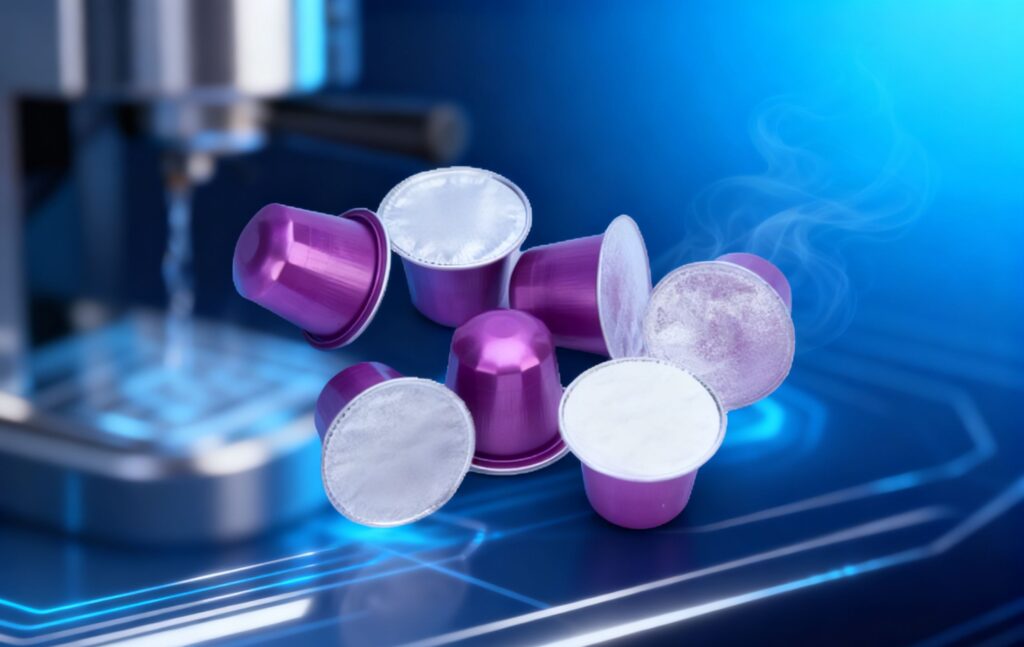
At its heart, Nespresso is all about recreating authentic, Italian-style espresso. The system's high-pressure extraction is the key. It forces hot water through the finely ground coffee in the capsule, producing a concentrated shot with a signature layer of crema. This focus on quality and authenticity is why users often describe the taste as superior and "like real espresso".
For a producer, this means a few things. First, the coffee grind must be perfect. An inconsistent grind will lead to poor extraction and a bad cup of coffee. Second, the capsule itself is a piece of precision engineering. It's typically small, holding about 5-7 grams of coffee, and often made of aluminum. I'm a big fan of aluminum because it offers a fantastic oxygen barrier, keeping the coffee fresh for a very long time. It is also infinitely recyclable, which is a big plus for environmentally conscious consumers.
After Nespresso's original patents expired, the market for "compatible" capsules exploded. This was a massive opportunity for independent coffee roasters. I remember helping a client in Germany who was a third-generation coffee roaster. He wanted to enter the capsule market but was worried about competing with a giant like Nespresso. We helped him select a machine, and he focused on producing high-quality, single-origin Nespresso-compatible capsules. His business took off because he offered a premium product to a market that already loved the format. This is the power of the Nespresso ecosystem outside of the United States.
So then, what is a K-Cup?
If Nespresso is about quality, K-Cup is about variety and convenience. This system, owned by Keurig, absolutely dominates one specific, massive market.
A K-Cup is the capsule for Keurig machines. It uses a low-pressure, drip-brew method, similar to a standard coffee maker. It's known for its huge variety of drinks, including coffees, teas, and hot chocolates, and its affordability.

Think of a K-Cup as a miniature, single-serving drip coffee filter. When you place a K-Cup in a Keurig machine, a needle punctures the top foil and another punctures the bottom. Hot water then fills the cup and drips through the ground coffee and an internal paper filter. The result is a cup of coffee that tastes very similar to what you'd get from a traditional American-style coffee pot. It's a milder, less intense brew compared to Nespresso.
The real strength of the K-Cup system isn't just its coffee; it's the incredible variety. There are over 75 different brands making K-Cups, including big names like Starbucks and Dunkin' Donuts. You can find hundreds of options, from flavored coffees to hot apple cider to iced tea. This huge selection is a major draw for consumers who want options.
For a producer, the K-Cup presents a different set of considerations. The capsules are larger than Nespresso pods, holding 9-12 grams of product. They are made of plastic, which has raised environmental concerns about waste. However, their low cost per cup is a huge selling point for consumers. If you want to compete in the K-Cup space, you are typically playing a game of volume. You need to produce a good, consistent product at a competitive price for a market that values convenience and choice above all else.
The Showdown: What are the key differences for a producer?
Choosing between them feels complex. The differences in taste, cost, and variety seem overwhelming. Let’s simplify it with a direct comparison for you, the producer.
Nespresso offers high-quality espresso via high-pressure brewing in smaller, often aluminum capsules. K-Cup provides a wider variety of drip-style drinks in larger plastic pods at a lower cost per cup. The choice is between premium quality and mass-market variety.
As a machine designer, I see two very different production challenges. It goes far beyond just the coffee. It impacts your raw material costs, your marketing strategy, and the machinery on your factory floor. Understanding these differences is critical before you spend a single dollar on equipment.
Let's break it down in a table, focusing on what matters to a coffee company.
| Feature | Nespresso | K-Cup (Keurig) |
|---|---|---|
| Brewing Method | High-Pressure Espresso (19 Bar) | Low-Pressure Drip Brew |
| Taste Profile | Strong, intense, rich crema | Smooth, mild, like filter coffee |
| Capsule Design | Small, compact (5-7g), often aluminum | Large, bulky (9-12g+), plastic with a filter |
| Product Variety | Primarily coffee, high-end tea | Huge variety: coffee, tea, cocoa, cider |
| Consumer Cost | Higher ($0.50 - $1.00+ per pod) | Lower ($0.30 - $0.60 per pod) |
| Geographic Market | Global Dominance (ex-USA) | USA Dominance |
| Consumer Focus | Quality, authenticity | Variety, convenience, price |
The most important takeaway from this table is the last two rows: market and consumer focus. A Nespresso consumer is often willing to pay more for what they perceive as a higher-quality, more authentic coffee experience. A K-Cup consumer is often looking for a quick, easy, and affordable cup of their favorite beverage, whatever that may be. You are not just choosing a capsule; you are choosing your customer.
How should a coffee company choose which capsule to produce?
The data can be confusing. You don't want to invest heavily in a product that won't sell. The decision is actually very simple: where are you selling?
It's all about geography. If your primary market is the USA, K-Cup is the dominant choice, holding over 90% of the single-serve market. For any other market globally, Nespresso is the clear leader and your safest bet.
This is the most important piece of advice I can give you. I have seen companies ignore it and pay a heavy price. Let's make this crystal clear.
The Decision Tree: Your Path to a Smart Choice
Your entire strategy hinges on answering one question: "Who is my customer?" And in the world of coffee capsules, "who" is inseparable from "where".
Scenario 1: Your Primary Market is the United States
If you are an American company selling to American consumers, you must seriously consider the K-Cup. It is the undisputed king of single-serve coffee in the U.S. Walk into any American supermarket, and you will see entire aisles dedicated to K-Cups. The user base is massive, and consumers are very comfortable with the format. While Nespresso has a presence and is growing in the premium segment, it is a niche player compared to Keurig. Choosing K-Cup in the U.S. means you are targeting the heart of the market. The competition is fierce, but the potential volume is enormous.
Scenario 2: Your Primary Market is Anywhere Else in the World
If your market is in Europe, Asia, Australia, South America, Canada, or anywhere outside the U.S., your choice is Nespresso. The situation is completely reversed. In these markets, Nespresso is the dominant standard. Consumers know it, they own the machines, and they are actively looking for new and interesting compatible capsules. The K-Cup format, on the other hand, has almost zero market penetration. I once had a potential client from France who was convinced he could introduce K-Cups there. I strongly advised against it. He would not just be launching a new coffee brand; he would be trying to build an entire ecosystem from scratch. That's a battle you don't want to fight. Stick with the established standard in your region.
Are there filling machines that can handle both?
Buying two separate production lines is expensive and wastes space. What if you want to target the U.S. with K-Cups but also sell Nespresso online internationally?
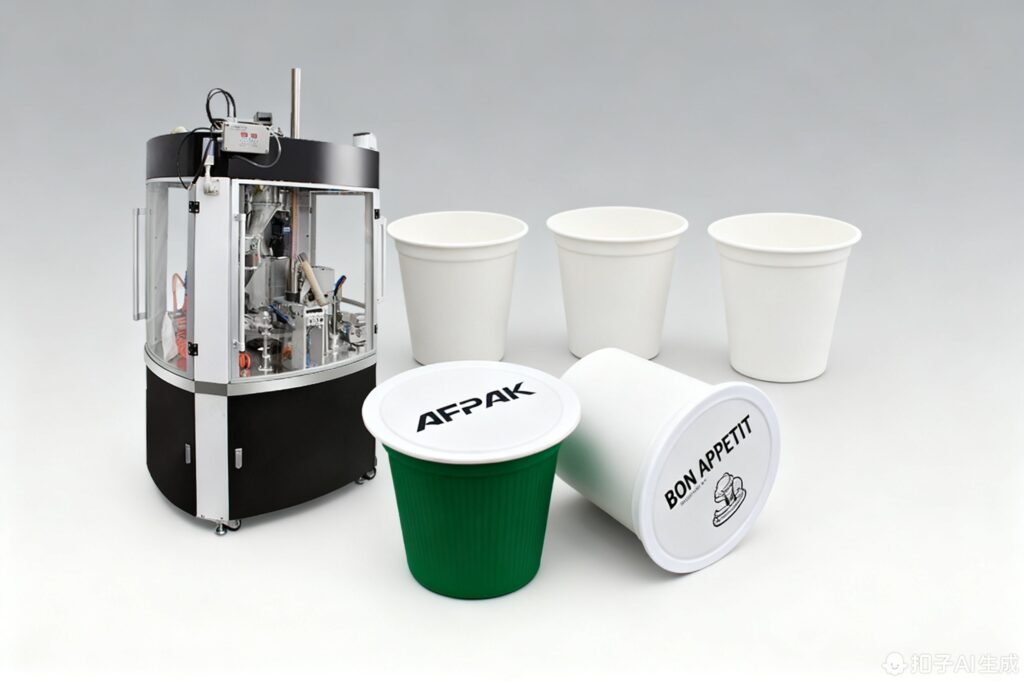
Yes, flexible machines can produce both. We recommend the AFPAK RN1S model. It uses quick-change molds to handle both Nespresso and K-Cup capsules, offering great versatility for a small investment of around $25,000 USD.
This is a problem I have spent years solving for my clients. Startups and medium-sized businesses need flexibility. They need to be able to test markets and adapt quickly without breaking the bank. That's why we pioneered the concept of a single machine with interchangeable formats.
From a mechanical engineering standpoint, the core functions of filling a Nespresso pod and a K-Cup are similar. The process is: drop an empty cup, fill it with a precise amount of coffee, and seal it with a lid. Good filling machines have adjustable auger fillers, so changing the fill weight from 6 grams for Nespresso to 10 grams for a K-Cup is simple. The real challenge is in the parts that physically hold and handle the capsules.
Our solution is the AFPAK RN1S coffee capsule filling machine. We designed it to be the perfect first machine for a growing coffee company. It’s a robust, reliable machine, but its true genius is its modularity. You can buy the machine with two complete sets of tooling—one for Nespresso and one for K-Cup. An operator can swap from one format to the other in just 30 minutes. It requires no complex training. This means you can run a batch of K-Cups for a local U.S. distributor in the morning and then switch over to produce Nespresso capsules for your global online store in the afternoon. All on one machine, with one investment. At a price point starting around $20,000, it makes entering both markets incredibly accessible.
And when you grow, we grow with you. AFPAK offers a full range of solutions, from this flexible starter model to fully automated, high-speed lines that can fill, seal, box, and case-pack your products. We provide a complete solution, ensuring your investment is safe and your production can scale with your success.
Conclusion
Your choice between Nespresso and K-Cup depends entirely on your target market. AFPAK offers flexible machinery to help you start smart, adapt quickly, and protect your investment.